
Guide
Glutes, hips and legs in a strict pull-up: why "squeeze your glutes" works
Your legs do not lift you over the bar, but they decide whether the lats pull one solid body or a swinging chain. Squeezing the glutes tilts the pelvis back, flattens the lower back and lets the abdominals hold the hollow position, so the force from your hands reaches your toes instead of leaking into a hip swing. Here is the anatomy of the hips and legs, what the research shows, the cues that work and the drills that teach a quiet lower body.
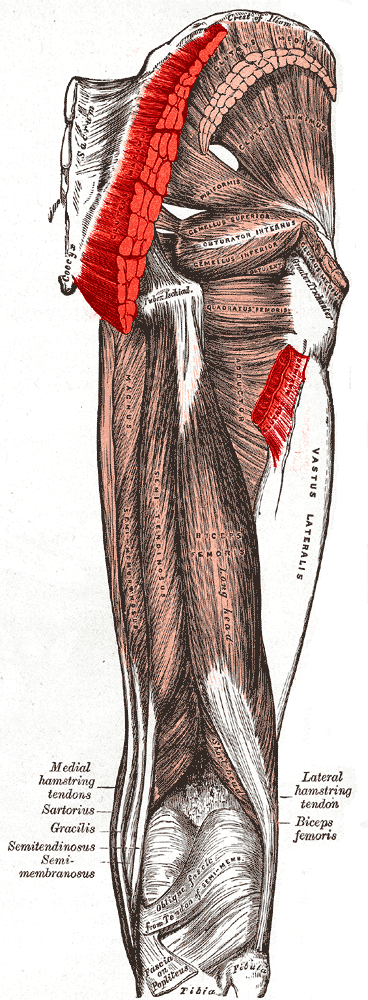
Which hip and leg muscles matter in a pull-up?
Nothing below the ribs moves the bar. The lower body shapes the platform the upper body pulls from: the pelvis. Six muscle groups set its position.[1][3]
| Muscle | Origin | Insertion | Nerve | Main action | Role in a pull-up |
|---|---|---|---|---|---|
| Gluteus maximus | Posterior ilium, sacrum, coccyx, sacrotuberous ligament, thoracolumbar fascia | Iliotibial tract and gluteal tuberosity of the femur | Inferior gluteal nerve (L5–S2) | Hip extension, external rotation | Locks the hips straight, tilts the pelvis back, cancels swing |
| Gluteus medius and minimus | Outer surface of the ilium between the gluteal lines | Greater trochanter | Superior gluteal nerve (L4–S1) | Hip abduction, pelvic levelling | Keep the pelvis level so the legs hang as one unit |
| Hamstrings (semitendinosus, semimembranosus, biceps femoris) | Ischial tuberosity; short head of biceps femoris from the linea aspera | Medial tibia, medial tibial condyle, fibular head | Tibial division of the sciatic nerve (L5–S2); short head by the common fibular division | Hip extension, knee flexion | Help the glutes tilt the pelvis back; stop the knees piking |
| Iliopsoas (psoas major, iliacus) | Lumbar vertebral bodies and transverse processes; iliac fossa | Lesser trochanter | Lumbar plexus L1–L3 (psoas); femoral nerve L2–L4 (iliacus) | Hip flexion, lumbar stabilisation | Should stay quiet; when it dominates it pulls the pelvis forward and the legs up |
| Rectus femoris | Anterior inferior iliac spine and rim of the acetabulum | Patella and tibial tuberosity via the quadriceps tendon | Femoral nerve (L2–L4) | Hip flexion, knee extension | Straightens the knee for "long legs"; must not pull the pelvis forward |
| Adductors (magnus, longus, brevis, gracilis) | Pubis and ischial ramus; hamstring part of adductor magnus from the ischial tuberosity | Linea aspera, adductor tubercle, medial tibia | Obturator nerve (L2–L4); hamstring part of magnus by the tibial nerve | Hip adduction; magnus also extends the hip | Hold the legs together and add hip extension |
The gluteus maximus is the largest muscle of the gluteal region, supplied mainly by the inferior gluteal artery, and part of it arises from the thoracolumbar fascia, the same sheet the opposite lat attaches to.[1] That is why a glute squeeze is felt through the back: both muscles pull on one fascial sling. The gluteus medius and minimus keep the pelvis level.[2] The iliopsoas is the primary hip flexor and a lumbar stabiliser; the psoas arises from the lumbar vertebrae, which is why a hard hip flexor contraction is felt in the lower back.[3] The hamstrings and the hamstring part of adductor magnus arise from the ischial tuberosity and extend the hip.[4][5]
What does the pelvis do in each phase of a strict pull-up?
Dead hang
With relaxed hips the heavy pelvis tips into anterior tilt: the lower back hollows, the ribs flare and the feet drift behind you. A light glute and hamstring contraction tilts the pelvis back and straightens the line. In standing, a maximal posterior pelvic tilt moved the pelvis about 8.7 degrees and reduced lumbar lordosis by about 9 degrees; an anterior tilt increased lordosis by about 10.8 degrees.[8] Our dead hang guide covers how long to hang.
Initiation
The shoulder blades depress first. If the glutes are already on, that first pull lifts the whole body; if they are off, the chest rises, the hips lag behind and a swing starts.
Mid-pull
The lats and elbow flexors work. The glutes and adductors hold the legs straight and together, the abdominals keep the ribs down, the hip flexors do nothing. Legs drifting forward mean the iliopsoas and rectus femoris have switched on and the pelvis is following them into anterior tilt.
Top
Kicking the knees up at the chin to buy the last centimetre is hip flexion, a kip in miniature. Keep the hips extended and let the lats finish.
Lowering
Keep the squeeze all the way down; the swing usually starts when the pelvis drops into the hang.
Why does "squeeze your glutes" actually work?
- It sets the pelvis and therefore the spine. The gluteus maximus and hamstrings extend the hip and tilt the pelvis posteriorly; with the pelvis tucked, lumbar lordosis drops and the abdominals can hold the ribs down: the hollow position.[1][4][8] Over-active hip flexors do the opposite: the iliopsoas pulls the lumbar spine and pelvis forward into anterior tilt.[3]
- It makes the body one segment. Force from the lats travels down a stiff pelvis and legs and lifts all of it; a loose hip lets the legs swing, which wastes force and makes every rep start from a different place.
- It may add a little drive. Contracting muscles remote from the prime mover can raise its force output, a phenomenon called concurrent activation potentiation. In twelve trained men, isometric knee-extensor torque was about 14.6 percent higher on average with jaw clenching, bilateral gripping and a breath hold combined.[7] Nobody has tested a glute squeeze on lat output in a pull-up, so this is plausible, not proven.
Straight, crossed or bent: how should the legs hang?
- Straight and together, toes pointed. Longest lever, lowest centre of mass. A long pendulum swings slowly, so this is the easiest position to keep still, and the only one where glutes, adductors and hamstrings all work.
- Crossed ankles. Acceptable if the hips stay extended. The problem is what usually comes with it: a twisted pelvis and bent knees, so the glutes relax and the hip flexors take over.
- Knees bent. Raises the centre of mass, so the swing gets faster, and the hip flexors hold the shins up. Fine for low bars, not for learning control.
What does the research say about the lower body in pull-ups?
The clearest data comes from comparing strict and kipping pull-ups. In eleven athletes, kipping increased the maximal hip angle by about 49 degrees and the knee angle by about 57 degrees, and raised activation of the rectus abdominis by about 29, the external oblique by 22, the iliopsoas by 26 and the tensor fasciae latae by 14 percent of MVIC, while biceps brachii activation dropped by about 27 percent.[6] Read the other way: in a strict pull-up the hips and knees stay nearly still, the hip flexors stay quiet, and the arms pay for it. That is the point if a stronger upper body is the goal.
Which cues work?
- "Squeeze a coin." Imagine a coin between your glutes. The adductors join in and the legs come together.
- "Point your toes." Runs tension through the calves and hamstrings; the legs become part of the lift.
- "Long legs." Push the heels toward the floor. The knees straighten and the pelvis cannot pike.
- "Ribs down, tailbone forward." The posterior tilt itself.
Which drills teach a quiet lower body?
None need a pull-up; pair them with the first pull-up progression or band-assisted pull-ups.
- Glute bridge with a two-second hold: 2 sets of 12. Finish with the hips straight, not arched.
- Hollow hold with glute squeeze: 3 sets of 15–30 seconds. Lower back pressed into the floor, toes pointed; if the back lifts, bend the knees.
- Dead hang with posterior tilt: 3 sets of 10–20 seconds. Tuck the tailbone forward and squeeze; the feet come slightly in front of the bar.
- Hanging leg position practice: 5 × 5 seconds. Let the legs go loose, then rebuild: toes, knees, coin, ribs.
- Scapular pull-ups with the squeeze on: 3 sets of 6–8. See the scapular muscles guide.
- Half-kneeling hip flexor stretch: 2 × 30 seconds each side, back-leg glute squeezed.
Medical notes: when is the lower body a problem?
For orientation, not diagnosis.
- Hip flexor tightness. A tight psoas pulls the lumbar spine and pelvis toward anterior tilt, and iliopsoas tendinopathy, bursitis and snapping hip are recognised problems in active people.[3] On the bar it shows as a back that will not flatten.
- Anterior pelvic tilt and low back pain. More anterior tilt means more lordosis, and the reverse tilt reduces it.[8] That does not make tilt the cause of back pain; it means the hollow position is trainable.
- Tendon and muscle strains. Pain on the outside of the hip, worse lying on that side, points to the gluteus medius tendon, a common site of tears.[2] Hamstring injuries usually come from sprinting rather than hanging, but sudden pain at the sit bone during a kip is worth checking.[4] Groin pain that does not settle may involve the adductors.[5]
See a clinician if back pain comes with numbness or weakness in a leg or wakes you at night, if hip or groin pain lasts more than two or three weeks despite easing off, if the hip catches painfully, or if pain started suddenly during a kip.
Common lower-body mistakes
- Piking the legs forward. Hip flexors on, glutes off. Fix: point the toes and push the heels down.
- Arching the back at the top. Fix: ribs down, chest to bar, stop the rep where the hollow holds.
- Crossing the legs and twisting. Fix: legs straight and together until the position is automatic.
- Letting go at the bottom. Keep the squeeze through the lowering, pause, then pull.
The pull-up mistakes guide covers the upper-body errors. The app's sessions start with hollow holds and scapular work for this reason: the lower body learns its job before the lats are asked to do theirs.
Frequently asked questions
Should I squeeze my glutes during pull-ups?
Yes. A light, continuous squeeze tilts the pelvis back, flattens the lower back and keeps the body in one line, so the pull from the lats lifts everything at once instead of starting a swing. It does not need to be maximal; enough to keep the hips still.
Should my legs be straight or bent in a pull-up?
Straight and together with the toes pointed, if the bar is high enough. That position keeps the glutes, adductors and hamstrings working and the centre of mass low, which makes the body easiest to keep still. Bend the knees only when the bar is low.
Is crossing my ankles bad?
Not by itself, as long as the hips stay extended and the pelvis stays square. In practice crossed ankles usually come with bent knees and a twisted pelvis, which switches the glutes off. Learn straight legs first, then cross if you must.
Why do my hip flexors burn or cramp during pull-ups?
Because they are holding the legs up. If the legs drift forward or the knees are bent, the iliopsoas and rectus femoris are working instead of the glutes. Point the toes, push the heels down and squeeze the glutes, and the burn usually moves to the abdominals, where it belongs.
Can pull-ups hurt my lower back?
A strict pull-up with a tucked pelvis loads the spine very little. Back discomfort usually comes from an arched, anteriorly tilted position, from hard kipping or from a tight hip flexor that keeps the pelvis forward. If pain comes with leg numbness, weakness or night pain, see a clinician.
Sources
- Elzanie A, Borger J. Anatomy, Bony Pelvis and Lower Limb, Gluteus Maximus Muscle. StatPearls [Internet], NCBI Bookshelf, 2023.
- Shah A, Bordoni B. Anatomy, Bony Pelvis and Lower Limb, Gluteus Medius Muscle. StatPearls [Internet], NCBI Bookshelf, 2023.
- Bordoni B, Varacallo MA. Anatomy, Bony Pelvis and Lower Limb: Iliopsoas Muscle. StatPearls [Internet], NCBI Bookshelf, 2026.
- Hu Y, Raja A. Anatomy, Bony Pelvis and Lower Limb, Hamstring Muscle. StatPearls [Internet], NCBI Bookshelf, 2026.
- Jeno SH, Launico MV, Schindler GS. Anatomy, Bony Pelvis and Lower Limb: Thigh Adductor Magnus Muscle. StatPearls [Internet], NCBI Bookshelf, 2023.
- Dinunzio C, Porter N, Van Scoy J, Cordice D, McCulloch RS. Alterations in kinematics and muscle activation patterns with the addition of a kipping action during a pull-up activity. Sports Biomech, 2019.
- Ebben WP, Leigh DH, Geiser CF. The effect of remote voluntary contractions on knee extensor torque. Med Sci Sports Exerc, 2008.
- Levine D, Whittle MW. The effects of pelvic movement on lumbar lordosis in the standing position. J Orthop Sports Phys Ther, 1996.
Keep reading
- Breathing and bracing for pull-ups: the diaphragm, intra-abdominal pressure and when to inhale, hold and exhale
- The core in pull-ups: anti-extension, the hollow body and the link between your hands and your hips
- Pull-up muscles worked: what you're really training
- Latissimus dorsi and pull-ups: the anatomy of your biggest pulling muscle
- Scapular muscles and pull-ups: an anatomy lesson for trainees
- Dead hang benefits: what it does, how long to hang and how to progress
- Pull-up mistakes: 7 form errors that hold you back (and the fixes)
Let the plan do the counting.
PullUp Master runs this exact progression for you: it places you on the right block, guides every set with clips and a rest timer, and rewrites your next session from how the last one felt — with an estimate of how many weeks your first rep is away.
PullUp Master is a training tool, not medical advice. Train within your ability.