
Guide
Breathing and bracing for pull-ups: the diaphragm, intra-abdominal pressure and when to inhale, hold and exhale
Breathe in the hang, brace before the elbows bend, exhale through the pull or hold briefly through the sticking point, and breathe again as you lower. The diaphragm, the deep abdominals, the pelvic floor and the multifidus form a pressurised cylinder that stiffens the lumbar spine and gives the lats something solid to pull on. Here is the anatomy, the research on intra-abdominal pressure and the Valsalva manoeuvre, a phase-by-phase breathing pattern, drills, and the signs that mean a clinician should look at you.
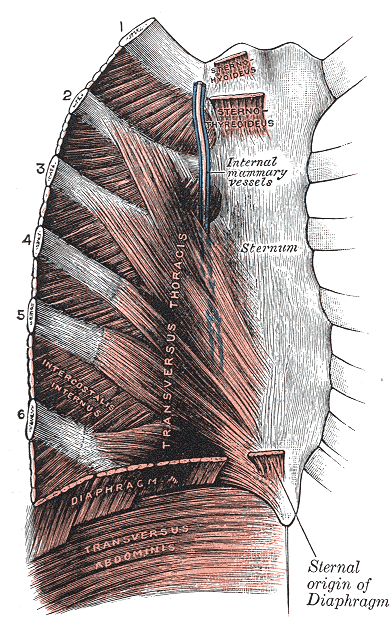
Which muscles form the "cylinder" around your spine?
Bracing is a pressurised box, not one muscle: the diaphragm is the roof, the pelvic floor the floor, the transversus abdominis and obliques the front and side walls, the multifidus and erector spinae the back wall. Contracting together, they raise the pressure inside the abdomen and stiffen the lumbar spine,[3] which lets the lats pull the body instead of folding it.
| Structure | Origin | Insertion | Nerve | Main action | Role in a pull-up |
|---|---|---|---|---|---|
| Diaphragm | Sternal part (xiphoid), costal part (lower six ribs), lumbar part (right crus L1–L3, left crus L1–L2, arcuate ligaments) | Central tendon | Phrenic nerve (C3–C5) | Flattens and draws air in; raises abdominal pressure with the abdominals | Roof; breathes in the hang, holds the lid during the pull |
| Transversus abdominis | Costal cartilages 7–12, thoracolumbar fascia, iliac crest, inguinal ligament | Linea alba, pubic crest | Thoracoabdominal T7–T11, subcostal T12, iliohypogastric and ilioinguinal L1 | Compresses the abdomen, raises intra-abdominal pressure | The belt; tightens before the elbows bend |
| External oblique | Outer surface of ribs 5–12 | Linea alba, pubic tubercle, iliac crest | Thoracoabdominal T7–T11, subcostal T12 | Trunk flexion, rotation to the opposite side, compression | Stops rib flare and swinging mid-pull |
| Internal oblique | Thoracolumbar fascia, iliac crest, inguinal ligament | Ribs 10–12, linea alba, pubic crest | Thoracoabdominal T7–T11, subcostal T12, L1 | Trunk flexion, rotation to the same side, compression | Side wall; pelvis to lower ribs |
| Pelvic floor (levator ani, coccygeus) | Pubis, tendinous arch of the obturator fascia, ischial spine | Perineal body, coccyx | Pudendal nerve and sacral branches (S2–S4) | Supports the organs, resists pressure | Floor; without it pressure leaks downward |
| Multifidus | Sacrum, posterior iliac spine, mammillary processes of the lumbar vertebrae | Spinous processes 2–4 segments above | Medial branches of the posterior rami | Segmental stiffness, control of extension and rotation | Back wall; stops the lumbar segments shearing |
Why is the diaphragm two muscles in one?
The diaphragm is a dome of muscle and tendon between chest and abdomen. When it contracts the dome flattens, the chest grows, pressure in it falls and air flows in. It is the primary muscle of breathing, and the oesophagus, aorta and inferior vena cava pass through it.[1]
It also has a postural job. Hodges and Gandevia recorded the diaphragm while people moved one arm repetitively: the diaphragm and the transversus abdominis stayed tonically active throughout, and intra-abdominal pressure rose in proportion to the forces of the movement. Co-contraction produces a sustained rise in pressure, while breathing happens by the two working against each other to reshape an already pressurised cavity.[4] So the diaphragm must hold the lid down and move it at the same time; the harder the pull, the more the postural job wins and the less air you can move.
How does intra-abdominal pressure stiffen the spine and link the lats to the pelvis?
Cholewicki and colleagues measured trunk stiffness with a sudden load-release test while volunteers raised their intra-abdominal pressure to 40 and 80 percent of maximum. In flexion, stiffness rose by 21 and 42 percent; in lateral bending by 16 and 30 percent.[5] A stiffer trunk resists buckling; that is the point of bracing, a torso that is one piece.
In a pull-up this matters because the transversus abdominis and the internal oblique arise partly from the thoracolumbar fascia,[2] the same sheet that the lower fibres of the latissimus dorsi pull on (see our latissimus article). If the abdominal wall is slack, the ribs flare, the lower back arches and part of the lat's pull bends the spine instead of lifting the body. Pressurised, they move as one unit.
What does the Valsalva manoeuvre do, and when is it appropriate?
A Valsalva manoeuvre is a forceful exhalation against a closed glottis: pressure in the chest and abdomen jumps and the circulation responds in four phases of rising and falling blood pressure.[8] Hackett and Chow's review found a brief Valsalva unavoidable with loads above about 80 percent of maximum or lighter loads taken to failure; it raises intra-abdominal pressure in step with effort and probably helps spine stability; the health risks, they concluded, remain unconfirmed.[6]
Unconfirmed is not absent. MacDougall's group measured arterial pressure directly in five experienced bodybuilders: during double-leg presses to failure the group mean peaked at 320/250 mmHg, one subject exceeded 480/350, and even single-arm curls to failure reached 255/190.[7] A pull-up to failure is a long isometric effort; assume similar spikes.
The rule: a one- to two-second hold on the hardest part of a heavy rep is useful; a hold across a whole set is not. StatPearls advises caution in coronary artery disease and retinopathy, because the manoeuvre can occasionally trigger fainting, arrhythmias or retinal bleeding.[8] With high blood pressure, a heart condition, a hernia, pregnancy or recent abdominal or eye surgery, ask your clinician before using breath-holds.
How should you breathe in each phase of a pull-up?
Dead hang
Breathe here. Ribs stacked over the pelvis, one full exhale to bring the ribcage down, then a medium breath into the belly and the sides, not the shoulders.
Initiation
Brace on that inhale: tighten the abdominal wall around the air, squeeze the glutes lightly and pull the shoulder blades down (see the scapular muscles guide).
Mid-pull
Either exhale through pursed lips while you pull, keeping the wall tight so pressure leaks slowly, or hold through the sticking point and release at the top. The first suits sets of five or more, the second heavy singles and weighted reps.
Top
Arms overhead, lats and abdominals shortened, ribcage lifted: the diaphragm has little room to descend, so inhaling here hauls the ribs up and the back into an arch. Finish the exhale, or keep the hold, and start down.
Lowering
Two to three seconds under control. In the last third, as the elbows straighten, breathe in again. The hang refills the cylinder.
How do you breathe in long sets and max tests?
Above eight reps, breathe once per rep: in during the lowering and the hang, out through the pull. The brace softens enough for air to move but never fully releases. Extra breaths at the bottom belong in an active hang, not a passive one (see the dead hang guide). In a max test the last reps slow down and your body wants to hold its breath for whole reps. Allow a hold on the sticking point, but force an exhale at the top of every rep, or the pressure spike stacks and you finish dizzy.
Which drills teach breathing and bracing?
- Crocodile breathing. Face down, forehead on the hands. Breathe so the belly presses into the floor; two minutes. Teaches the diaphragm, not the chest, to move.
- 90/90 breathing. On your back, feet on a box, hips and knees at ninety degrees. Long exhale until the lower ribs drop, pause, inhale into the sides without flaring. Five breaths, three rounds.
- Dead bug with exhale. Same position, arms up. Exhale as you lower one arm and the opposite leg, lower back pressed down. Three sets of eight per side.
- Hollow hold with breathing. Shoulders and legs off the floor, lower back down, breathing in short cycles for 20 to 30 seconds. A brace you can breathe behind.
- Hang and breathe. Active hang, five slow breaths with the ribs down, then one brace and one scapular pull-up. Three to five rounds.
Five minutes before pull-up sessions; if you are still building your first pull-up, do them daily; the brace carries over to negatives and band-assisted reps.
Which mistakes are common?
- Holding the breath for the whole set. Every rep adds to the pressure spike; you get light-headed and the last reps are fought with a red face.[7]
- Chest breathing. Lifting the shoulders to inhale moves little air and undoes the shoulder-blade position. Breath goes down and out, not up.
- Losing the brace at the top. Gasping at the bar flares the ribs and arches the back; one of the quieter pull-up mistakes.
- Bracing every rep like a max. Match tension to load; an easy rep needs a moderate brace. And never suck the belly in: hollowing lowers pressure.
When does breathing need a clinician?
Orientation, not diagnosis.
- Dizziness or blackout. A long hold reduces blood return to the heart and releasing it swings pressure the other way. Fainting, chest pain or palpitations need a medical review before you train hard again.[8]
- Exertional headache. A sudden severe headache during a hard rep often follows the pressure spike MacDougall measured,[7] but a first episode, or the worst headache of your life, needs urgent assessment to rule out a vascular cause.
- Hernias. Raised pressure pushes on the weak points of the abdominal wall.[2] A new bulge in the groin or at the navel, especially one that appears when you brace, needs an examination first.
- Pregnancy, surgery, blood pressure and heart disease. The pressures measured in lifters are high enough that anyone with a cardiac history should get clearance and avoid prolonged holds;[6][7] after surgery or in pregnancy, breathe continuously and follow your clinician's plan.
Frequently asked questions
Should I breathe in or out when pulling up?
Inhale in the hang, brace, then exhale through the pull or hold briefly through the hardest point and exhale at the top. Inhale again as you lower. Never try to inhale at the top; the diaphragm has no room there.
Is holding your breath during pull-ups dangerous?
A one- to two-second hold on a heavy rep is normal and helps spine stability. Holding through a whole set stacks blood-pressure spikes and causes dizziness. If you have high blood pressure, a heart condition, a hernia or are pregnant, ask a clinician before using any breath-hold.
Why do I get dizzy after a max set of pull-ups?
Usually because you held your breath for several reps. The hold reduces blood return to the heart and the release swings pressure the other way. Exhale at the top of every rep and rest in an active hang. Fainting or chest pain needs a medical review.
Should I brace hard on every pull-up?
Match the brace to the load. Bodyweight reps well within your capacity need a moderate brace that still lets air move; weighted reps and max tests need a firmer brace with short holds. Over-bracing easy reps just makes you gasp.
What is the best breathing drill for pull-ups?
Hang and breathe: an active hang with five slow breaths, ribs down and body still, then one brace and one scapular pull-up. It rehearses the exact sequence of the rep. Crocodile and 90/90 breathing teach the diaphragm to descend on the floor first.
Sources
- Bains KNS, Kashyap S, Lappin SL. Anatomy, Thorax: Diaphragm. StatPearls [Internet], NCBI Bookshelf, 2023.
- Varacallo MA, Scharbach S, Al-Dhahir MA. Anatomy, Anterolateral Abdominal Wall Muscles. StatPearls [Internet], NCBI Bookshelf, 2023.
- Akuthota V, Nadler SF. Core strengthening. Arch Phys Med Rehabil, 2004.
- Hodges PW, Gandevia SC. Changes in intra-abdominal pressure during postural and respiratory activation of the human diaphragm. J Appl Physiol, 2000.
- Cholewicki J, Juluru K, Radebold A, Panjabi MM, McGill SM. Lumbar spine stability can be augmented with an abdominal belt and/or increased intra-abdominal pressure. Eur Spine J, 1999.
- Hackett DA, Chow CM. The Valsalva maneuver: its effect on intra-abdominal pressure and safety issues during resistance exercise. J Strength Cond Res, 2013.
- MacDougall JD, Tuxen D, Sale DG, Moroz JR, Sutton JR. Arterial blood pressure response to heavy resistance exercise. J Appl Physiol, 1985.
- Srivastav S, Jamil RT, Dua A, Zeltser R. Valsalva Maneuver. StatPearls [Internet], NCBI Bookshelf, 2025.
Keep reading
- Glutes, hips and legs in a strict pull-up: why "squeeze your glutes" works
- The core in pull-ups: anti-extension, the hollow body and the link between your hands and your hips
- Latissimus dorsi and pull-ups: the anatomy of your biggest pulling muscle
- Scapular muscles and pull-ups: an anatomy lesson for trainees
- Pull-up muscles worked: what you're really training
- Dead hang benefits: what it does, how long to hang and how to progress
- Pull-up mistakes: 7 form errors that hold you back (and the fixes)
Let the plan do the counting.
PullUp Master runs this exact progression for you: it places you on the right block, guides every set with clips and a rest timer, and rewrites your next session from how the last one felt — with an estimate of how many weeks your first rep is away.
PullUp Master is a training tool, not medical advice. Train within your ability.