
Guide
Elbow tendon pain and pull-ups: golfer's elbow, tennis elbow, biceps tendinopathy and how to train through it
Elbow pain from pull-ups is usually a tendon problem, not a muscle problem: the common flexor tendon on the inside of the elbow (golfer's elbow), the common extensor tendon on the outside (tennis elbow) or the biceps tendons at the elbow and shoulder. Tendons adapt far more slowly than muscle, so they get overloaded when you add reps and sets faster than they can keep up. Most people can keep training with less volume, a friendlier grip and slow, heavy loading; this page shows how, and lists the signs that mean you need a clinician.
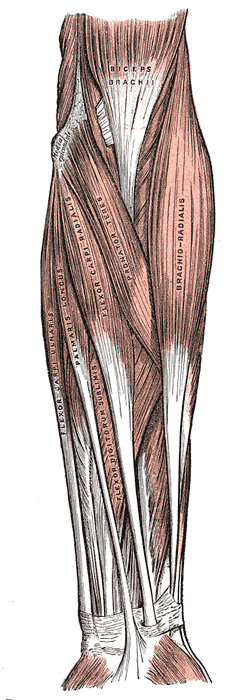
Why do tendons lag behind muscles?
A tendon is a rope of type I collagen that carries muscle force to bone. Muscle is rebuilt continuously and strengthens within weeks of a new stimulus. Tendon is different: a study that dated human Achilles tendon with the carbon-14 left by nuclear bomb tests found that the tendon core is laid down during growth and essentially not renewed afterwards, while muscle showed continuous turnover.[1] Tendons still adapt, but slowly.
That gap is the classic beginner story: muscles and nervous system improve fast, you add reps every week, and the tendons quietly fall behind. Cook and Purdam describe tendon pathology as a continuum: a tendon loaded beyond its capacity first becomes reactive (swollen and painful but structurally intact), then enters disrepair, and only after long overload becomes degenerative. The early stages are reversible if you adjust the load.[2]
Which tendons do pull-ups load, and where does each one hurt?
Five structures take most of the strain. The muscles themselves are covered in our biceps and brachialis article and forearm and grip article; here the focus is the tendons.
| Tendon | Attaches | Loaded by | Typical pull-up pain pattern |
|---|---|---|---|
| Common flexor tendon (medial epicondylitis, golfer's elbow) | Medial epicondyle; a shared tendon about 3 cm long from pronator teres, flexor carpi radialis, palmaris longus, flexor digitorum superficialis (median nerve) and the humeral head of flexor carpi ulnaris (ulnar nerve); sits just in front of the ulnar collateral ligament[3] | Forceful gripping, resisted wrist flexion and pronation[3] | Ache on the inside of the elbow, worst on chin-ups and a hard squeeze; tender just below the bony bump |
| Common extensor tendon (lateral epicondylitis, tennis elbow) | Lateral epicondyle; the extensor carpi radialis brevis (ECRB) origin is the usual culprit (radial nerve)[4] | Loaded gripping with the wrist in extension, radial deviation or supination[4] | Ache on the outside of the elbow in the dead hang and on wide pronated pull-ups |
| Distal biceps tendon | Bicipital tuberosity of the radius, with the bicipital aponeurosis into the forearm fascia[5] | Elbow flexion and, above all, supination under load[5] | Deep pain in the front of the elbow crease, worst at the top of a chin-up and on slow lowering |
| Long head of biceps tendon | Supraglenoid tubercle and superior labrum; runs through the bicipital groove; helps stabilise the glenohumeral joint[5] | Traction in the hang, the stretch at the bottom | Ache at the front of the shoulder, worse in a passive dead hang; a painful click may involve its labral anchor (SLAP) |
| Brachialis tendon | Coronoid process and tuberosity of the ulna | Elbow flexion in every grip | Rare; deep ache in front of the elbow after many negatives |
Two rows matter most. The common flexor tendon is the shared origin of the muscles that grip and pronate, so a hard squeeze loads it on every rep. And the biceps is the forearm's most powerful supinator once the elbow is bent, which is the chin-up position.[5]
Where in the pull-up is each tendon loaded most?
Dead hang
The elbow is straight, so the flexor tendons are at full length under bodyweight and the long head of the biceps is under traction through its labral anchor.[5] In a pronated grip the wrist extensors, including ECRB, hold the wrist against the bar.[4] A passive hang on sore elbows is a loaded stretch, not a rest.
Initiation
EMG shows the rep starting with the lower trapezius and pectoralis major before the biceps and lats take over.[6] The grip, and so the common flexor tendon, is already flat out.
Mid-pull
The biceps averaged 78 to 96 percent of its maximal contraction across pull-up variations.[6] The distal biceps tendon and the brachialis peak here.
Top
The elbow is most bent; in a chin-up the biceps works as supinator and flexor at once.[5] Bending the wrists to get the chin over the bar loads the common flexor tendon.
Lowering
Tendon strain peaks in the eccentric phase, which is why most rehab exercises live here. A three-second descent is tendon training; dropping into a locked elbow is a tendon insult.
How does grip change where the elbow hurts?
- Supinated (chin-up). The biceps and pectoralis major were significantly more active in the chin-up than in the pull-up.[6] The forearm is held supinated against the bar, so the biceps tendon and the flexor-pronator origin carry more load. Golfer's elbow in trainees is mostly a chin-up and curl problem.
- Pronated (pull-up). The wrist extensors hold the wrist, which shifts load laterally; a wide grip adds radial deviation, a known trigger for tennis elbow.[4] See chin-up vs pull-up.
- Neutral (palms facing). The forearm sits between pronation and supination and the wrist stays straight, so neither epicondyle takes a rotation moment. Most people with elbow pain tolerate it best, and activation across grips is similar enough that you lose little.[6]
What does the research say about training with tendon pain?
Most tendon trials used the Achilles and patellar tendons, so take these as principles rather than exact prescriptions.
- You do not need to stop. In a randomised trial of 38 patients with Achilles tendinopathy, those who kept running and jumping under a pain-monitoring model improved as much over 12 months as those who rested for six weeks.[7]
- Isometrics reduce pain immediately. In six volleyball players with patellar tendinopathy, one bout of isometric holds cut pain on a loaded test from 7.0 to 0.17 out of 10, the relief lasted at least 45 minutes and maximal strength rose about 19 percent; isotonic reps helped far less.[8]
- Heavy slow resistance works as well as eccentrics. In 58 patients with Achilles tendinopathy, 12 weeks of slow concentric-eccentric training matched the classic eccentric programme at 12 and 52 weeks, with better compliance (92 vs 78 percent).[9]
- Isolated wrist eccentrics help the elbow. In 21 patients with chronic tennis elbow, adding an eccentric wrist extensor exercise with a rubber bar (the Tyler twist) to standard physiotherapy gave far larger gains over about seven weeks: disability fell 76 vs 13 percent, pain 81 vs 22 percent.[10] The mirror-image wrist flexor version is used for golfer's elbow.
Which pain rule tells you whether to continue?
The Achilles trial let training continue as long as pain stayed within an agreed ceiling, settled by the next morning and did not climb week to week.[7] For elbow tendons we use a more conservative traffic light:
- Green: pain up to 3 out of 10 during the set, back to baseline within 24 hours. Continue.
- Amber: 4 to 5 out of 10, or more morning stiffness than the day before. Cut volume by a third, slow the lowering, go neutral, keep the isometrics.
- Red: more than 5 out of 10, pain that climbs during the session or from week to week, or night pain. Stop pull-ups for now and get assessed.
How do you keep training and get out of it?
An eight-week outline for a reactive or early-stage elbow tendon that fits inside a normal pull-up workout plan:
- Weeks 1 to 2: calm it down. Halve pull-up volume, switch to neutral grip, stop above the sore range if the hang hurts. Twice a day: wrist flexor and extensor isometrics against a table edge, 5 holds of 45 seconds with pain at or below 3, plus a 45-second curl hold at 90 degrees.[8] Negatives with a 3 to 5 second descent, 3 sets of 3 to 5.
- Weeks 3 to 6: rebuild capacity. Three times a week, heavy slow resistance for the forearm: wrist curls and reverse wrist curls, 3 seconds up and 3 down, 3 to 4 sets of 6 to 8 with a load that is hard by the last rep, plus slow hammer curls.[9] Rubber-bar twists, 3 sets of 15 twice daily, extensor version for lateral pain, flexor version for medial.[10] Add pull-up reps back by about 10 percent a week while the light stays green.
- Weeks 7 to 8: reintroduce the triggers. One chin-up set per session, then two, lowered slowly. Keep two forearm sessions a week for good; tendons prefer a steady load to an occasional big one.[2]
If you cannot do a pull-up yet, the same rules apply to band-assisted pull-ups and rows.
Which signs need a clinician?
- A sudden pop at the front of the elbow, bruising and weak supination. This can be a distal biceps tendon rupture, which usually needs surgical repair and does best with a prompt diagnosis.[5]
- Numbness or tingling in the ring and little finger. The ulnar nerve runs just behind the medial epicondyle, next to the common flexor origin; nerve symptoms are not tendinopathy.[3]
- Locking, catching or giving way, or a deep painful shoulder click in the hang, which may involve the biceps anchor on the labrum.[5]
- Night pain, rest pain, swelling, redness or fever. Tendinopathy hurts with load; pain that wakes you needs another explanation.
Which mistakes keep elbow tendons sore?
- Adding reps every session. Muscle lets you; tendon does not.[1] Progress by about 10 percent a week.
- Resting completely. Rest did not beat monitored loading in trials.[7]
- Stretching or massaging the painful spot hard. Compression tends to make a reactive tendon worse.[2]
- Only chin-ups, or only pull-ups. Rotate grips across the week; a plateau is often the first sign the elbows are cooked.
- Death grip and bent wrists. Hold the bar firmly, not maximally, wrists straight through the top.
Frequently asked questions
Why does the inside of my elbow hurt after pull-ups?
That is usually the common flexor tendon at the medial epicondyle, the origin of the muscles that grip and pronate, which clinicians call golfer's elbow. Chin-ups, a very tight grip and bent wrists load it most. Reduce volume, switch to a neutral grip and load the wrist flexors slowly and heavily rather than resting completely.
Can I keep doing pull-ups with golfer's elbow or tennis elbow?
Usually yes, if pain stays at or below 3 out of 10 during the set and settles within 24 hours. Cut volume, use a neutral grip, lower slowly and add daily isometrics and rubber-bar eccentrics. Stop and get assessed if pain climbs through a session or from week to week.
How long does elbow tendinopathy take to heal?
A reactive tendon often settles in a few weeks once load is adjusted; a tendon that has been sore for months usually needs 8 to 12 weeks of progressive loading, and tendon structure keeps changing for longer. Tendons turn over far more slowly than muscle, so patience is part of the treatment.
Which grip is best for elbow pain?
A neutral grip, palms facing each other, is tolerated best by most people with either medial or lateral elbow pain, because the wrist stays straight and the forearm is not twisted. Chin-ups load the inside of the elbow and the biceps tendon most; wide pronated pull-ups load the outside.
When is elbow pain from pull-ups an emergency?
A sudden pop at the front of the elbow with bruising and weak palm-up rotation can be a distal biceps tendon rupture, which usually needs surgery soon. Numbness in the ring and little finger, locking, night pain or swelling with redness and fever also need a clinician rather than a training fix.
Sources
- Heinemeier KM, Schjerling P, Heinemeier J, Magnusson SP, Kjaer M. Lack of tissue renewal in human adult Achilles tendon is revealed by nuclear bomb 14C. FASEB J, 2013.
- Cook JL, Purdam CR. Is tendon pathology a continuum? A pathology model to explain the clinical presentation of load-induced tendinopathy. Br J Sports Med, 2009.
- Li D, Hammad A, Kaiser K. Medial Epicondylitis (Golfer's Elbow). StatPearls [Internet], NCBI Bookshelf, 2026.
- Buchanan BK, Varacallo MA. Lateral Epicondylitis (Tennis Elbow). StatPearls [Internet], NCBI Bookshelf, 2023.
- Hsu D, Anand P, Mabrouk A, Chang KV. Biceps Tendon Rupture. StatPearls [Internet], NCBI Bookshelf, 2023.
- Youdas JW, Amundson CL, Cicero KS, et al. Surface electromyographic activation patterns and elbow joint motion during a pull-up, chin-up, or Perfect-Pullup rotational exercise. J Strength Cond Res, 2010.
- Silbernagel KG, Thomeé R, Eriksson BI, Karlsson J. Continued sports activity, using a pain-monitoring model, during rehabilitation in patients with Achilles tendinopathy: a randomized controlled study. Am J Sports Med, 2007.
- Rio E, Kidgell D, Purdam C, et al. Isometric exercise induces analgesia and reduces inhibition in patellar tendinopathy. Br J Sports Med, 2015.
- Beyer R, Kongsgaard M, Hougs Kjær B, Øhlenschlæger T, Kjær M, Magnusson SP. Heavy slow resistance versus eccentric training as treatment for Achilles tendinopathy: a randomized controlled trial. Am J Sports Med, 2015.
- Tyler TF, Thomas GC, Nicholas SJ, McHugh MP. Addition of isolated wrist extensor eccentric exercise to standard treatment for chronic lateral epicondylosis: a prospective randomized trial. J Shoulder Elbow Surg, 2010.
Keep reading
- The core in pull-ups: anti-extension, the hollow body and the link between your hands and your hips
- Pectoralis major, teres major and the lat's little helper: the chest and armpit muscles that pull you up
- Biceps, brachialis and brachioradialis in pull-ups
- Grip strength for pull-ups: forearm anatomy, why it fails first and how to train it
- Rotator cuff and pull-ups: how the shoulder works and how to keep it healthy
- Pull-up plateau: why your reps stopped going up and how to break through
- Pull-up workout plan: a weekly routine to add reps
Let the plan do the counting.
PullUp Master runs this exact progression for you: it places you on the right block, guides every set with clips and a rest timer, and rewrites your next session from how the last one felt — with an estimate of how many weeks your first rep is away.
PullUp Master is a training tool, not medical advice. Train within your ability.