
Guide
Pectoralis major, teres major and the lat's little helper: the chest and armpit muscles that pull you up
Your chest helps you do pull-ups. The sternocostal head of the pectoralis major starts the pull from a dead hang, and the teres major, a short muscle at the bottom of the shoulder blade that shares an insertion zone with the lats, finishes the adduction and extension at the top. Here is the anatomy of the chest and armpit muscles, what EMG studies say about chin-ups, pull-ups and grip width, how to cue and train them, and when chest or front-of-shoulder pain needs a clinician.
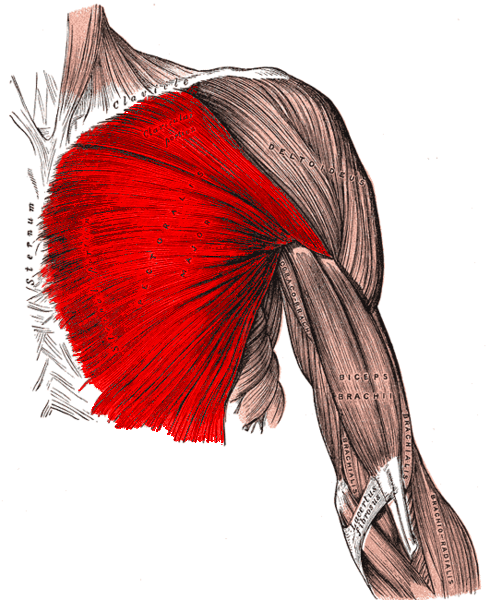
Which chest and armpit muscles are involved in a pull-up?
Three muscles most people file under "chest" do real work every time you pull your chin over a bar: pectoralis major, teres major and pectoralis minor, with the small coracobrachialis as a helper. They form the front and back walls of your armpit, and their tendons land next to the latissimus dorsi.[1][2]
| Muscle | Origin | Insertion | Nerve (roots) | Main actions | Role in a pull-up |
|---|---|---|---|---|---|
| Pectoralis major, clavicular head | Medial half of the clavicle | Lateral lip of the bicipital groove | Lateral pectoral nerve (C5–C7) | Flexion, adduction, internal rotation | Minor; pulls the arm in on a close or supinated grip |
| Pectoralis major, sternocostal head | Sternum, upper costal cartilages, external oblique aponeurosis | Lateral lip of the bicipital groove | Medial pectoral nerve (C8–T1), plus lateral pectoral nerve | Adduction, internal rotation, extension from a flexed position | Starts the pull from the hang; strongest on a chin-up |
| Teres major | Inferior angle of the scapula, posterior surface | Medial lip of the bicipital groove | Lower subscapular nerve (C5–C7) | Adduction, extension, internal rotation | Backs up the lats mid-pull, finishes extension at the top |
| Pectoralis minor | Ribs 3–5 near the costal cartilages | Coracoid process | Medial pectoral nerve (C8–T1) | Protracts, depresses and tilts the scapula forward | Should stay quiet; a tight one tips the shoulder blade forward at the top |
| Coracobrachialis | Coracoid process | Medial humeral shaft | Musculocutaneous nerve (C5–C7) | Flexion, weak adduction | Helps keep the humeral head seated in the hang |
The pectoralis major is a fan: the clavicular head from the collarbone, the larger sternocostal head from the breastbone and upper rib cartilages, both twisting into one flat tendon on the front of the humerus, fed mainly by the thoracoacromial artery. Because the lower sternocostal fibres run upward to the arm, they can pull a raised arm back down toward the trunk, which is exactly what a pull-up asks for.[1]
The teres major is a thick, short muscle running from the inferior angle of the scapula to the medial lip of the same groove, supplied by the circumflex scapular and thoracodorsal arteries. Its actions copy the latissimus dorsi so closely that anatomy teachers call it the "lat's little helper".[2]
Why is the teres major called the lat's little helper?
Look at where the tendons land. The lat tendon wraps around the lower border of the teres major and inserts in the floor of the bicipital groove; the teres major inserts on the medial lip next to it; the pectoralis major inserts on the lateral lip across the groove. Three muscles from three directions converge on a few centimetres of bone, and all three adduct and internally rotate the humerus.[1][2] That is why the back wall of your armpit (lat plus teres major) and the front wall (pec major) feel like one unit when you pull hard.
Some people have the link built in. A muscular or fibrous slip called the axillary arch, or Langer's arch, can split off the latissimus dorsi, cross the armpit and join the front of the upper limb near the pec major tendon. A dissection series of 400 axillae found it in 27, and with the arm abducted and externally rotated most of those arches touched the axillary nerves and vessels.[3]
What do these muscles do in each phase of a pull-up?
Dead hang
With straight arms overhead, the sternocostal pec major and teres major are on a long stretch, and the coracobrachialis helps keep the humeral head seated. A tight pec minor already tilts the shoulder blade forward here. Our dead hang guide covers hanging actively.
Initiation
In an EMG study of pull-ups and chin-ups, the timing of peak activation suggested the rep is initiated by the lower trapezius and pectoralis major and completed by the biceps and latissimus dorsi.[4] The chest starts the movement because, from a fully flexed arm, pulling the humerus toward the trunk is extension, and the sternocostal head is a strong extensor from that position.[1]
Mid-pull
Here the teres major earns its nickname. As the elbow passes shoulder height, the lats, teres major and pec major all drive the humerus toward the body. Average pec major activity in that study was 44–57 percent of maximum, next to 117–130 percent for the lats.[4] No pull-up study has isolated the teres major with surface electrodes, but its line of pull puts it in the same job.[2]
Top
Once the elbows pass behind the trunk, the lat loses leverage and the teres major and posterior deltoid finish extension. A short pec minor pulls the coracoid down and forward, the scapula tilts, and you round your shoulders to reach the bar instead of pulling your chest to it.[1]
Lowering
The same muscles work eccentrically at lower intensity: across four grip variants, pec major, biceps and brachioradialis all showed higher average activity in the concentric than the eccentric phase.[5] Lower slowly; it keeps the pec tendon under controlled load.
Pull-up, chin-up or wide grip: which heads work?
The pectoralis major and biceps were significantly more active during the chin-up than the pull-up, the lower trapezius more active in the pull-up, and lat activity did not differ.[4] A supinated grip puts the elbows in front of the body and lines the sternocostal fibres up with the direction of pull. To feel your chest contribute, do a chin-up and finish with the elbows driving toward the ribs.
In lat pull-downs, concentric pec major activity was higher with a close grip, a wide front grip and a supinated grip than with a wide grip behind the neck; the teres major was recorded too but showed no grip-dependent pattern.[6] Going wider does not buy you more: with pronated grips of one, one and a half and two times shoulder width, lat, trapezius and infraspinatus activation was similar, and the 6-rep max was slightly lower with the widest grip.[7] Peak and average activation were also similar across pronated, supinated, neutral and rope pull-ups in strength-trained men.[5] Grip shifts the share of work modestly, not the muscles involved.
How do you feel and cue these muscles?
- "Elbows into your back pockets." Gets the lat and teres major extending the arm instead of the biceps curling it.
- "Squeeze an orange in your armpit" at the top. The adduction squeeze recruits pec major and teres major together.[1][2]
- Chest to the bar, not chin. Lifting the sternum stops the scapula tipping forward and gives the sternocostal fibres a straight line of pull.
Which drills build these muscles before your first pull-up?
- Straight-arm pulldown, cable or band, 3 sets of 12–15. With locked elbows the lat, teres major and sternocostal pec do all the extension work without the biceps.
- Chin-up negatives, 3–5 reps with a 5-second lowering, supinated for more pec involvement.[4] See the first pull-up guide.
- Band-assisted chin-ups, 3 sets of 5–8, elbows finishing at the ribs. See band-assisted pull-ups.
- Doorway stretch for the pec minor: forearm on the frame at shoulder height, step through until you feel it under the collarbone, 3 holds of 30 seconds per side, ribs down.
- Posterior tilt work: prone Y raises with thumbs up, 2 sets of 10, and wall slides. These teach the lower trapezius to tip the shoulder blade back against a tight pec minor.
Medical notes: what can go wrong?
These notes are for orientation, not diagnosis.
- Pectoralis major tears. Most occur during the bench press, when the muscle contracts eccentrically with the arm extended and abducted, and they are most common in men between about 20 and 40. The sternocostal head tears most often, usually near the humeral insertion. People describe a pop, sudden pain, bruising and a loss of the front wall of the armpit. Complete tears in active people are usually repaired surgically.[8] A pull-up is not a typical cause, but catching yourself on a dropped rep with the arms wide applies the same forceful eccentric adduction.
- Pec minor tightness. A short pectoralis minor tilts the scapula forward and narrows the space under the acromion and behind the muscle itself, where the nerves and vessels to the arm pass; compression there is described as pectoralis minor syndrome, a form of thoracic outlet syndrome.[1] Typical signs are an ache at the front of the shoulder and tingling into the raised arm.
- Axillary arch. Rarely, a Langer's arch presses on the axillary nerves and vessels with the arm raised and turned out.[3] A variant, not an injury, but worth knowing if symptoms appear only overhead.
See a clinician if you felt or heard a pop in the chest or armpit, if there is bruising or a visible change in the shape of the chest, if the arm feels weak pulling in or across the body, if you get numbness, tingling or a cold hand with the arm overhead, or if anterior shoulder pain lasts more than two to three weeks despite easing off.[8]
Which mistakes waste the chest and teres major?
- Stopping at the chin. The last quarter of the rep is where the teres major and sternocostal pec finish adduction and extension.
- Very wide grip for "more lats". It shortens the range and drops the load without changing activation much.[7]
- Dropping into the hang. A ballistic catch with wide arms is the one way to copy the pec tear mechanism on a bar.[8]
- Only chin-ups, or only pull-ups. They bias the same muscles differently.[4] The pull-up workout plan rotates both; the app alternates grips for you.
Frequently asked questions
Do pull-ups work the chest?
Yes, as a helper. EMG studies put average pectoralis major activity at roughly 44 to 57 percent of maximum during pull-ups and chin-ups, far below the lats, and highest on a supinated chin-up. It is not a chest-building exercise, but the sternocostal head starts every rep.
What does the teres major do in a pull-up?
It adducts, extends and internally rotates the upper arm, the same actions as the latissimus dorsi, which is why it is nicknamed the lat's little helper. It is most useful in the top half of the rep, when the elbows pass behind the trunk.
Is a chin-up or a pull-up better for the pecs?
A chin-up. Pectoralis major and biceps activity were significantly higher in the chin-up than in the pull-up, while the lats were similar in both. Rotate both grips for complete development.
Why does the front of my shoulder hurt at the top of a pull-up?
A common cause is a tight pectoralis minor tilting the shoulder blade forward, which narrows the space at the front of the shoulder as you reach the bar. Stretch it in a doorway, strengthen the lower trapezius, and see a clinician if pain lasts more than two or three weeks or comes with tingling.
Can you tear a pec doing pull-ups?
Rarely. Pectoralis major tears mostly happen on the bench press under heavy eccentric load with the arm extended and abducted. Dropping hard into a wide-arm hang copies that mechanism, so lower under control. A pop, bruising and a change in the chest contour need prompt medical assessment.
Sources
- Baig MA, Bordoni B. Anatomy, Shoulder and Upper Limb, Pectoral Muscles. StatPearls [Internet], NCBI Bookshelf, 2023.
- Syros A, Rizzo MG. Anatomy, Shoulder and Upper Limb, Teres Major Muscle. StatPearls [Internet], NCBI Bookshelf, 2023.
- Georgiev GP, Tubbs RS. What is the axillary arch (of Langer)? J Anat, 2024.
- Youdas JW, Amundson CL, Cicero KS, et al. Surface electromyographic activation patterns and elbow joint motion during a pull-up, chin-up, or Perfect-Pullup rotational exercise. J Strength Cond Res, 2010.
- Dickie JA, Faulkner JA, Barnes MJ, Lark SD. Electromyographic analysis of muscle activation during pull-up variations. J Electromyogr Kinesiol, 2017.
- Signorile JF, Zink AJ, Szwed SP. A comparative electromyographical investigation of muscle utilization patterns using various hand positions during the lat pull-down. J Strength Cond Res, 2002.
- Andersen V, Fimland MS, Wiik E, Skoglund A, Saeterbakken AH. Effects of grip width on muscle strength and activation in the lat pull-down. J Strength Cond Res, 2014.
- Durant EJ, De Cicco FL. Pectoralis Major Tear. StatPearls [Internet], NCBI Bookshelf, 2023.
Keep reading
- Elbow tendon pain and pull-ups: golfer's elbow, tennis elbow, biceps tendinopathy and how to train through it
- The core in pull-ups: anti-extension, the hollow body and the link between your hands and your hips
- Latissimus dorsi and pull-ups: the anatomy of your biggest pulling muscle
- Scapular muscles and pull-ups: an anatomy lesson for trainees
- Chin-up vs pull-up: differences, muscles and which to choose
- Rotator cuff and pull-ups: how the shoulder works and how to keep it healthy
- Pull-up muscles worked: what you're really training
Let the plan do the counting.
PullUp Master runs this exact progression for you: it places you on the right block, guides every set with clips and a rest timer, and rewrites your next session from how the last one felt — with an estimate of how many weeks your first rep is away.
PullUp Master is a training tool, not medical advice. Train within your ability.